
Free product as lead gen
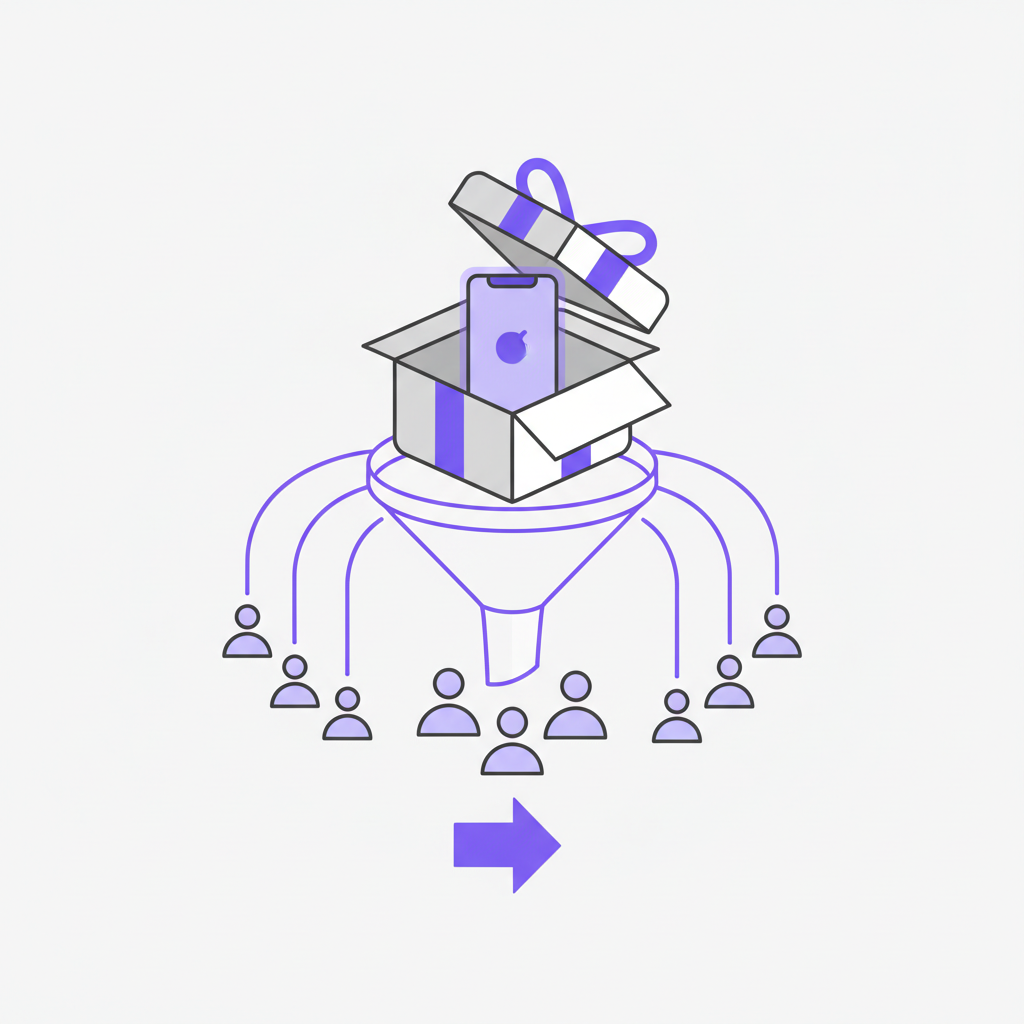
Instead of trying to sell your product to a cold audience, you give them something of value for free. This playbook shows you how to build a simple, free tool that solves a real problem for your target customers. You attract a steady stream of users, capture them as leads, build trust by delivering value, and then nurture them towards your core, paid product. It's the ultimate 'show, don't tell' marketing strategy.
- Effort
- High
- Cost
- Medium to High
- Time to first result
- 3-6 months
- Best for
- SaaS with a clear upsell path
Save this strategy and send it to my inbox
Get the full playbook - scripts, tool stack and checklist - delivered as a single email you can act on today.
No spam. One email, and only what is worth reading.
Why a Free Product Works as a Lead Magnet
A free tool bypasses the natural resistance people have to being sold to. Instead of a sales pitch, you're offering a solution. This allows a potential customer to experience your brand's quality and expertise without any risk or commitment. It's a powerful way to build trust and goodwill. When they eventually need a more powerful solution, your brand is the first one they'll think of because you've already helped them achieve a small win.
From a practical standpoint, a free tool is a lead generation machine that also doubles as a fantastic SEO asset. People search for solutions, not products. A well-made tool that solves a specific problem can rank on Google and attract high-intent organic traffic for years. These aren't just any leads--they are individuals who have actively demonstrated an interest in the problem your entire company is built to solve. This makes your funnel wider at the top and more qualified from the start.
Three real examples
HubSpot's Website Grader
HubSpot's Website Grader is a canonical example. You enter your website URL and email, and it gives you a free performance report. The tool is genuinely useful on its own but also perfectly tees up HubSpot's entire suite of marketing products as the solution to any problems it identifies. It has been a cornerstone of their inbound marketing strategy for over a decade.
Source: HubSpotSoftr's Free Templates
Softr, a no-code platform for building apps, offers a rich gallery of free, high-quality templates. Users can start building a client portal, internal tool, or marketplace with one click. To use a template, you must sign up for Softr. This seamlessly converts a visitor looking for a solution into a product user, placing them directly into the Softr ecosystem.
Source: Softr.ioBuffer's Pablo
Buffer, a social media scheduling tool, created Pablo--a super simple web app for creating beautiful images for social media posts. It's fast, free, and doesn't require a Buffer account. It builds immense brand awareness and goodwill. A subtle 'Create another image with Pablo' and a small Buffer logo are the only CTAs, making it a soft entry point to their brand.
Source: Buffer BlogConsider adding a subtle 'Powered by {Your Company}' link on the free tool to drive brand awareness and direct traffic back to your main site.
The step-by-step playbook
- 1
1. Identify a Recurring Pain Point
Find a small, specific, and recurring 'job to be done' that your ideal customer has. This should be directly related to the larger problem your paid product solves. Look in forums, communities, and your own support tickets for clues.
- 2
2. Scope the 'Minimum Viable Free Product'
Define the simplest possible version of a tool that can solve that one pain point effectively. It must be genuinely useful and stand on its own. Avoid the temptation to add extra features--focus on doing one thing perfectly.
- 3
3. Build the Tool with No-Code or a Small Sprint
Use tools like Softr.io or Dorik AI to build your tool without needing extensive engineering resources. If you have a dev team, dedicate a single, focused sprint to build and launch it. The goal is speed to market.
- 4
4. Add a 'Soft' Lead Capture
Don't hide the tool's value behind a signup form. Let the user experience it first. Then, ask for an email to 'get the results', 'save your work', or 'unlock a bonus feature'. Make the ask a logical next step, not a barrier.
- 5
5. Set Up Your Nurture Sequence
Create an automated 3-5 part email sequence using a tool like EmailOctopus. The first emails should offer more tips and value related to the free tool. Don't rush to the sales pitch.
- 6
6. Launch Like a Real Product
Your free tool deserves its own launch. Post it on Product Hunt, Hacker News, relevant subreddits, and Facebook groups. Treat it as a standalone product to maximize its reach and impact.
- 7
7. Introduce the Core Product
In your email sequence (around email 3 or 4), introduce your paid product as the logical next step. Frame it as the way to solve the much bigger problem that the free tool only hints at.
- 8
8. Measure and Analyze
Track your key metrics: number of free users, email capture rate, and the conversion rate from free user to paying customer. Use a tool like June.so to see how people are actually using your free tool and identify your most engaged leads.
The Nurture Email Template
Send this email 2-3 days after someone signs up for your free tool. It's designed to provide more value and make your main product feel like the natural next step, not a hard sell.
Subject: A few more tips for {Free Tool Name}

Hi {FirstName},

Hope you've found {Free Tool Name} useful for {the specific job it does}.

Many people who use it for {task} also find it helpful to {Pro Tip #1} and {Pro Tip #2}. It can really speed up the process.

Once you've done that a few times, you might notice that the next big challenge becomes {the larger problem your paid product solves}.

Our core product, {Paid Product Name}, is built specifically to handle that. It lets you {key benefit of paid product} in a fraction of the time.

No pressure at all, but if that sounds like your next step, you can see how it works here: {Link to Paid Product}

Cheers,
{Your Name}
Key Questions to Ask Yourself
- What's a small, painful, and recurring problem my ideal customer has?
- Can I build a 10x better solution for that tiny problem than what currently exists?
- Is the user of the free tool the same person who would buy my main product?
- How can I make the free tool valuable enough on its own that people will share it?
- What is the natural, non-pushy upsell path from the free tool to my core offering?
The first two questions are the most critical. A successful free tool solves a real, niche problem so well that it feels like magic to the user.
Recommended tools
Softr.io
Free, then from $49/moPerfect for building your free tool without code. Connect to Airtable or Google Sheets as a database and launch in a weekend.
Tally.so
Free, Pro from $29/moThe simplest way to create the signup form for your free tool. It's known for its generous free tier and clean, simple interface.
EmailOctopus
Free, then from $8/moAn affordable and easy-to-use email marketing platform to build your nurture sequence and send newsletters to your new leads.
June.so
From $39/moGet automatic product analytics to understand how people are using your free tool and identify which users are your best leads.
Prices are indicative and change - check the vendor before buying.
Do it faster with AI Prompts
Ideate Free Tools
I'm a founder of a SaaS product called {My Product Name} that does {Product Description}. My target customer is a {Customer Persona}. Brainstorm 10 ideas for a simple, single-purpose free tool I could build as a lead magnet. The tool should solve a small, recurring problem related to my main product's value proposition.
Write Nurture Emails
Write a 3-part email nurture sequence for users who just signed up for my free tool, {Free Tool Name}, which helps them {Function of Tool}. The goal is to build trust and then introduce them to my paid product, {Paid Product Name}, which solves {Larger Problem}. The tone should be helpful and not salesy.
Create Launch Copy
Write a Product Hunt launch post for my new free tool, {Free Tool Name}. It helps {Target Audience} to {Solve a Problem}. Tagline: {Tagline}. Key Features: {Feature 1}, {Feature 2}, {Feature 3}. It's 100% free. The call to action is to try the tool at {URL}.
Mistakes that kill this play
- Building a 'lite' version: Your free tool shouldn't be a crippled version of your paid product. It must be fully functional for its single purpose.
- Solving a non-existent problem: Don't build a tool you think is cool. Validate the problem with real potential users first.
- Asking for too much upfront: Don't gate the tool behind a huge form. Let users experience the value before asking for an email.
- Mismatch between free and paid users: The free tool must attract users who are a perfect fit for your paid product, otherwise you're just generating vanity metrics.
- No clear upsell path: The transition from the free tool's value to the paid product's value should be logical and obvious to the user.
- Forgetting to promote it: Building it is only half the job. You need a launch and promotion plan to get initial traction.
- Making it too complex: The best free tools are simple and deliver value in seconds. Complexity is the enemy.
Your First 7 Days
- Day 1: Ideation & Validation: Brainstorm 5 free tool ideas. Post a question in a niche subreddit or Facebook group to see which problem resonates most with your target audience.
- Day 2: Scope the MVFP: Outline the single core function of the winning idea. Define the absolute minimum features needed for it to be useful. Resist feature creep.
- Day 3: Choose Your Stack & Build Landing Page: Decide whether to use no-code (Softr.io, Dorik AI) or code. Set up a simple landing page and a signup form using a tool like Tally.so.
- Day 4: Start Building: Begin building the tool. If you're using no-code, you can likely build the entire first version today. Get it into the hands of one or two friendly users for feedback.
- Day 5: Write Nurture Sequence: Draft the first 3 emails that new users will receive in EmailOctopus. Focus on providing value and helping them succeed with the free tool.
- Day 6: Prepare Launch Assets: Write your launch copy for Product Hunt and other communities. Create screenshots, a short GIF, or a quick demo video showing the tool in action.
- Day 7: Launch!: Post your tool on Product Hunt, Hacker News, and other relevant channels. Spend the entire day engaging with every comment and piece of feedback you receive.
Save this strategy and send it to my inbox
Get the full playbook - scripts, tool stack and checklist - delivered as a single email you can act on today.
No spam. One email, and only what is worth reading.